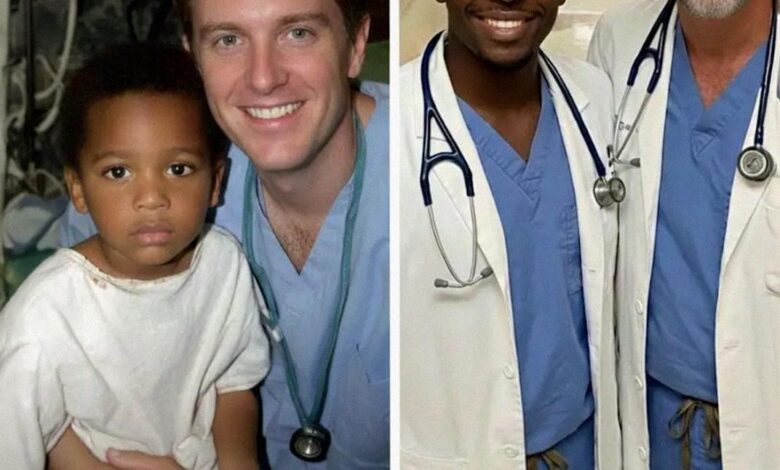
I have spent my entire career mending broken hearts, but none were as shattered as the one belonging to a six-year-old boy named Owen. As a pediatric surgeon, I am accustomed to the clinical detachment required to operate on the most fragile of lives, yet the moment I saw him, that detachment dissolved. He was impossibly small in his hospital bed, his pale face dominated by eyes that seemed to hold the weight of a century. His chart was a grim testament to a life barely started: a critical congenital heart defect.
Owen was a child of haunting politeness. He apologized for needing water; he apologized for the noise of the monitors. During our initial consultation, he didn’t ask if the surgery would hurt or if he would die. Instead, he asked for a story because the machines were too loud and frightening. I sat by his side and wove a tale about a knight with a ticking clock in his chest—a hero who learned that bravery wasn’t the absence of fear, but the ability to keep moving while your hands shook. Owen listened with his palms pressed flat against his sternum, feeling the erratic, failing rhythm of the life inside him.
The surgery was a success, a surgical triumph that should have been followed by the joyous tears of relieved parents. But when I entered his recovery room the following morning, the silence was absolute. There were no coats draped over chairs, no half-empty coffee cups, no exhausted mother stroking his hair. There was only Owen, a solitary stuffed dinosaur, and a cup of melted ice. When I asked where his parents were, he shrugged with a devastating lack of surprise. “They said they had to leave,” he whispered.
They hadn’t just left the room; they had vanished from his life. They signed every legal discharge form, left a disconnected phone number and a fictitious address, and walked out of the hospital forever. Whether they were crushed by the impending medical debt or simply broken people incapable of the burden of a sick child, I couldn’t say. All I knew was that Owen was now a ward of the state, a boy with a repaired heart and a spirit in splinters.
That night, I returned home to my wife, Nora. We had spent years navigating the quiet grief of infertility, our house filled with the echoes of the children we couldn’t have. When I told her about the boy who apologized for existing and the parents who chose a clean break over a difficult love, she didn’t cry. She simply asked where he was. Within forty-eight hours, Nora had seen him. Within a week, she had fallen in love.
The adoption process was a grueling gauntlet of bureaucracy, but the real work happened in the quiet corners of our home. For the first few months, Owen wouldn’t sleep in the bed we bought him. He slept on the hardwood floor, curled into a ball as if trying to minimize the space he occupied in the world. I took to sleeping in his doorway on a bedroll, not to keep him in, but to prove that I wasn’t going to leave. He called me “Doctor” and Nora “Ma’am,” maintaining a formal distance that served as a psychological shield.
The breakthrough came during a bout of flu. Half-delirious with fever, Owen felt Nora’s cool hand on his brow and murmured, “Mom.” When he woke fully and realized what he’d said, terror flooded his face. He began to sob, apologizing frantically. Nora held him close and told him through her own tears that he never had to apologize for loving someone. From that moment, the sunrise began. Slowly, the “Doctor” became “Dad,” and the boy who tried to disappear began to take up space. We raised him with a fierce consistency, teaching him that while some people make terrible choices out of fear, those choices never define the value of the person left behind.
Owen grew into a man of deep empathy and staggering intellect. Driven by the memory of the “knight with the ticking clock,” he followed me into medicine, eventually becoming a surgical resident at the very hospital where we had first met. We became colleagues, scrubbing in together for complex procedures, sharing the unspoken bond of men who had seen the inside of each other’s lives.
Twenty-five years after I first held his life in my hands, a Tuesday afternoon shattered our routine. A “Code Purple”—a personal emergency for staff—came through the OR. My wife, Nora, had been in a severe car accident. Owen and I ran through the corridors, the sterile hospital air suddenly feeling thick and suffocating.
We found Nora in the ER, bruised and trembling but alive. Hovering at the foot of her bed was a woman who looked like she had been carved out of hardship. Her clothes were threadbare, her hands were scraped raw, and her eyes were hollow with a familiar, ancient exhaustion. A nurse informed us that this woman had witnessed the crash, pulled Nora from the smoking wreckage, and stayed with her until the paramedics arrived. She had saved my wife’s life.
When Owen turned to thank the stranger, the air seemed to leave the room. He froze, his face turning a ghostly shade of grey. The woman’s gaze dropped to the collar of Owen’s scrubs, where the faint, silver line of his childhood surgical scar was visible. Her breath hitched, a jagged sound of recognition.
“Owen?” she whispered.
The revelation hit like a physical blow. This was the woman who had walked away twenty-five years ago. The silence in the trauma bay was heavy, punctuated only by the rhythmic beeping of monitors that sounded exactly like the ones Owen had feared as a child. She explained through choked sobs that Owen’s biological father had abandoned them the moment the medical costs were revealed. Alone, destitute, and terrified, she believed that leaving Owen at the hospital was the only way he would ever receive the life he deserved. She had spent two decades living in the shadow of that choice, her life a cycle of poverty and regret.
Owen stood at a crossroads of his own identity. He looked at Nora—the woman who had healed his nightmares and cheered at his graduation—and then at Susan, the woman who had given him life and then surrendered it. The anger was there, visible in the clenching of his jaw, but it was being eclipsed by something else.
“I don’t need a mother,” Owen said, his voice remarkably steady despite the tears in his eyes. “I have one.” He looked at Nora, then back at Susan. “But you saved her life today. You didn’t walk away this time.”
In a gesture of profound grace, Owen reached out. It wasn’t a cinematic reconciliation of long-lost family; it was a messy, painful, and human recognition of debt and forgiveness. Susan collapsed into his arms, weeping for the twenty-five years of birthdays and Christmases she had missed, and for the man her son had become in her absence.
We did not erase the past, but we refused to be held hostage by it. Nora, with the quiet strength that had always been the bedrock of our family, insisted on helping Susan find a way out of the homelessness she had endured. We helped her secure housing and medical care, not out of a sense of obligation, but because we understood that grace is only real when it is extended to the people who least expect it.
That Thanksgiving, our table was a testament to the complexity of the human heart. Susan sat among us, trembling as Owen placed his old stuffed dinosaur on the table—a bridge between the boy who was left and the man who stayed. I looked at the people gathered in the glow of the dining room: my wife, who had the vision to see a son where I saw a patient; my son, who had the courage to forgive the unforgivable; and a woman who had finally stopped running. I realized then that while I had spent my life repairing hearts with a scalpel, the most miraculous healing happens through the simple, radical act of staying.